
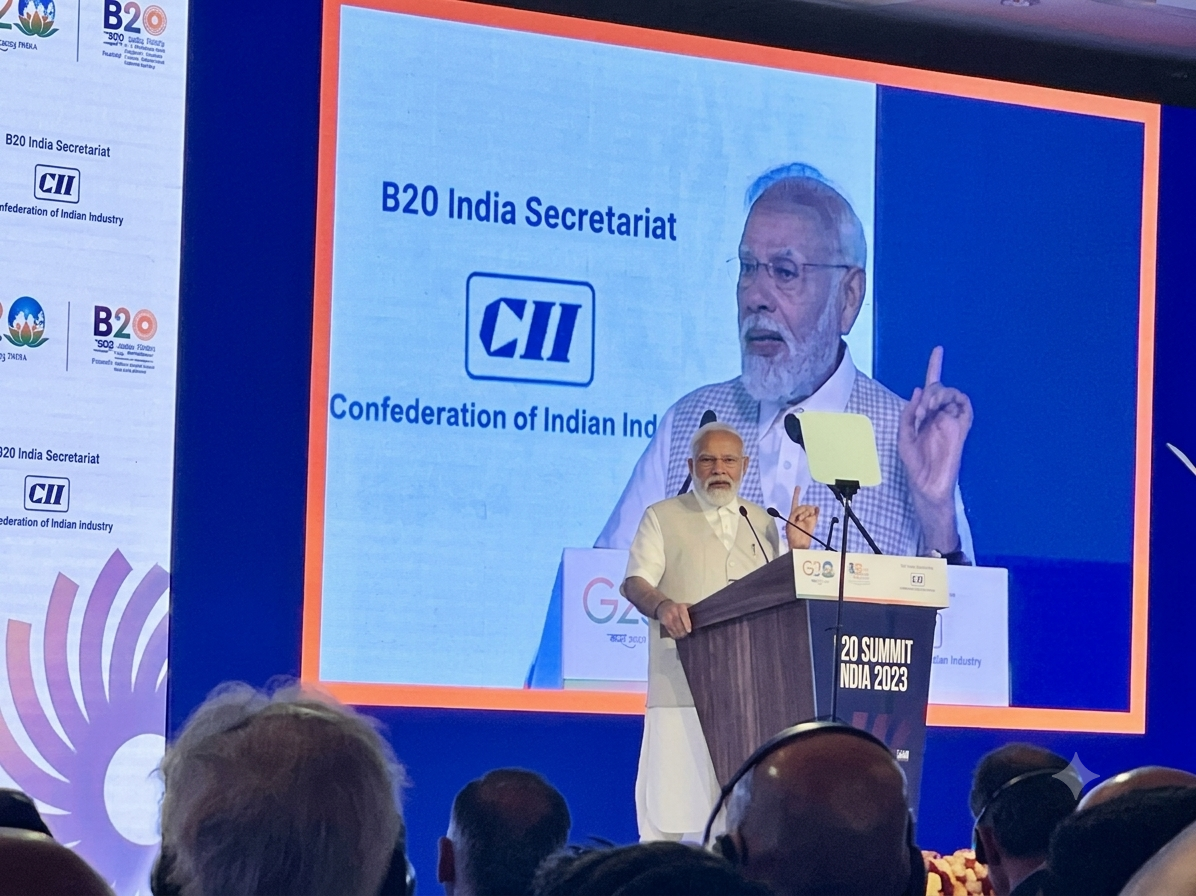
Three years ago, during India’s Group of Twenty (G20) Presidency, the Business 20 (B20) published its policy paper on Inclusive Global Value Chains for Resilient Global Trade and Investment. Our Managing Partner Marco Förster served on the task force behind it, alongside business leaders and trade experts from across the G20. Read the policy paper.
What the task force called for
The paper set out four priorities: more resilient and sustainable value chains, faster digitalisation of trade, fewer barriers to trade in services, and wider participation for small businesses and least developed countries. Among its concrete asks were a working dispute settlement system at the World Trade Organization (WTO), interoperable rules for digital trade and paperless customs, and a globally aligned approach to sustainability reporting.
Where things stand in 2026
- Dispute settlement: the WTO Appellate Body remains inactive. The WTO’s 14th Ministerial Conference in Yaoundé in March 2026 ended without a ministerial declaration. The interim appeal arrangement used by members in its place grew to 61 members, covering around 60% of global trade.
- Digital trade: the multilateral moratorium on customs duties on electronic transmissions lapsed on 30 March 2026, for the first time since 1998. At the same conference, 66 members covering around 70% of global trade agreed to move ahead with an E-Commerce Agreement covering paperless trade, e-signatures and e-invoicing.
- Investment: 165 of 166 WTO members supported bringing the Investment Facilitation for Development Agreement into the WTO rulebook, but without full consensus it remains outside. Its 129 participants have committed to press ahead.
- Sustainability reporting: more than 45 jurisdictions are now adopting or otherwise using the International Sustainability Standards Board (ISSB) standards, a step towards the alignment the paper sought.
Our view
Much of what the task force recommended is moving forward, but through coalitions of willing countries rather than global consensus. For companies, that means value chain decisions increasingly depend on which agreements a market has joined, not only on cost and capacity. That is the kind of question we help clients answer.
More from Stratburg
- Speaking at the S-GE webinar on the EFTA-Vietnam Free Trade Agreement
- Stratburg quoted in Bloomberg on Vietnam’s USD 65 billion high-speed rail bet
- Executive Roundtable with Asia Society Switzerland on Vietnam’s economic transformation
Rethinking where your value chain should sit? Get in touch.